
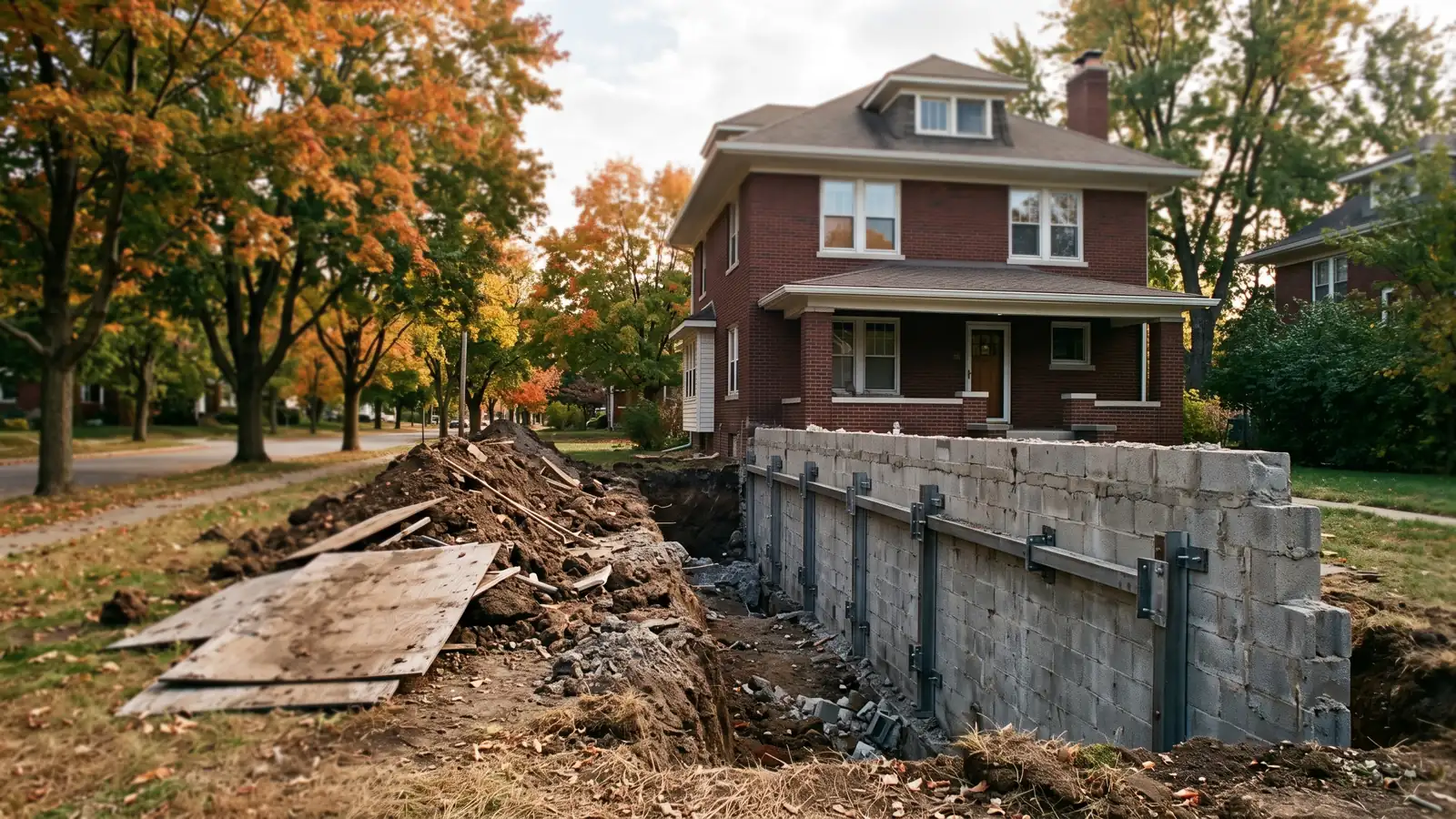
Retaining Wall Repairs by Wall Type
A retaining wall fails when the soil behind it pushes harder than the wall was built to resist. Water is usually what tips the balance: wet clay is heavier, and water trapped behind a wall adds pressure of its own. Each wall type below fails in its own way and gets its own repair.
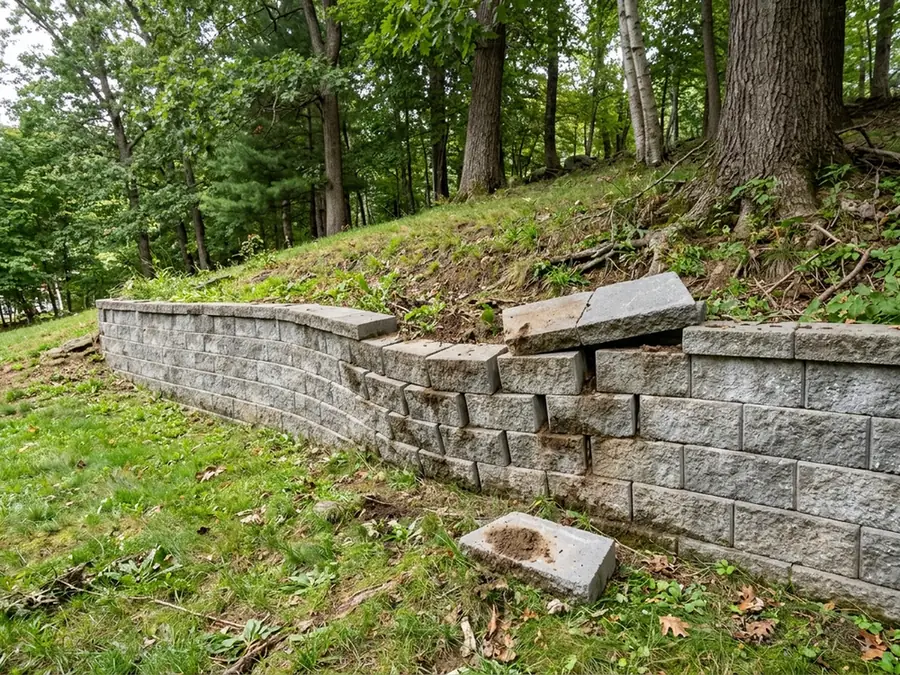
Leaning Block Retaining Walls
Many newer landscape walls are segmental block: dry-stacked concrete units with lips or pins that lock each course to the one below, set back slightly so the wall leans into the slope. Taller ones have layers of geogrid running back into the soil. When they bulge, tip or drop at one end, the usual causes are a base that wasn't compacted, too little gravel behind the blocks, no drain pipe, geogrid that is missing or too short, or a driveway or slope above adding weight the wall wasn't designed for.
A block wall can't be pushed back. The leaning section is taken down, numbered or stacked, and rebuilt on a compacted base with the bottom course buried. The industry guide sets an absolute minimum of 6 inches for that buried depth. HomeGuide's December 2025 range for replacing a block wall section is $15 to $55 per square foot of wall face.
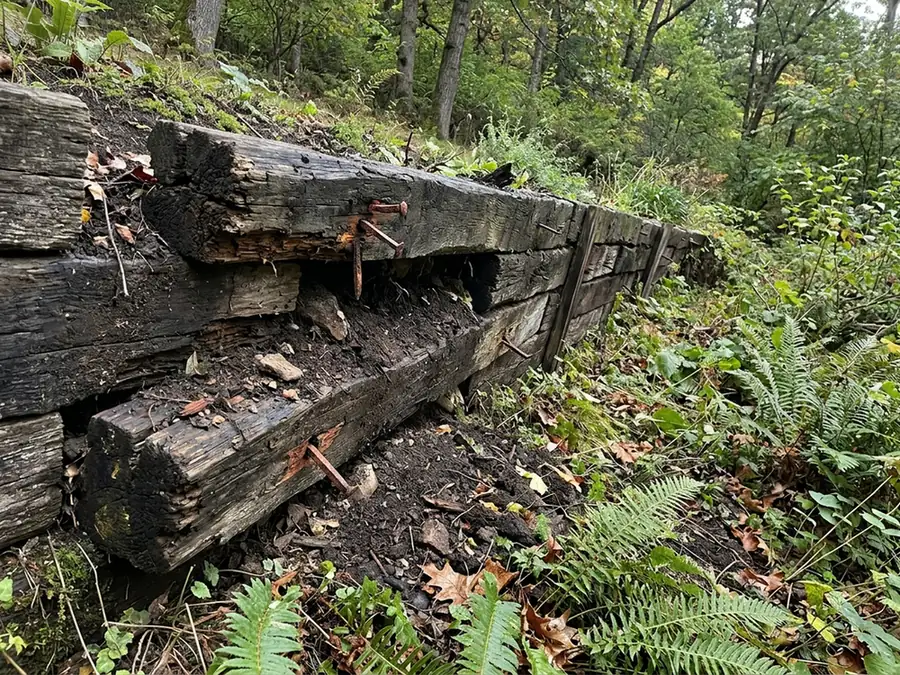
Timber Retaining Walls
Timber and railroad-tie walls were built in a lot of yards in past decades. They hold until the wood rots, and the first wood to go is often the part you can't see: the "deadmen," the ties that run back into the slope to anchor the face. Once those are gone, the face leans forward and soil spills between the ties.
Rotted timber doesn't patch well. The usual choice is to rebuild, either in new pressure-treated timber with fresh deadmen or in segmental block. HomeGuide puts wood or tie sections at $10 to $40 per square foot. Our view: price both. Timber is cheaper to put back, but block lasts longer in soil that stays wet.
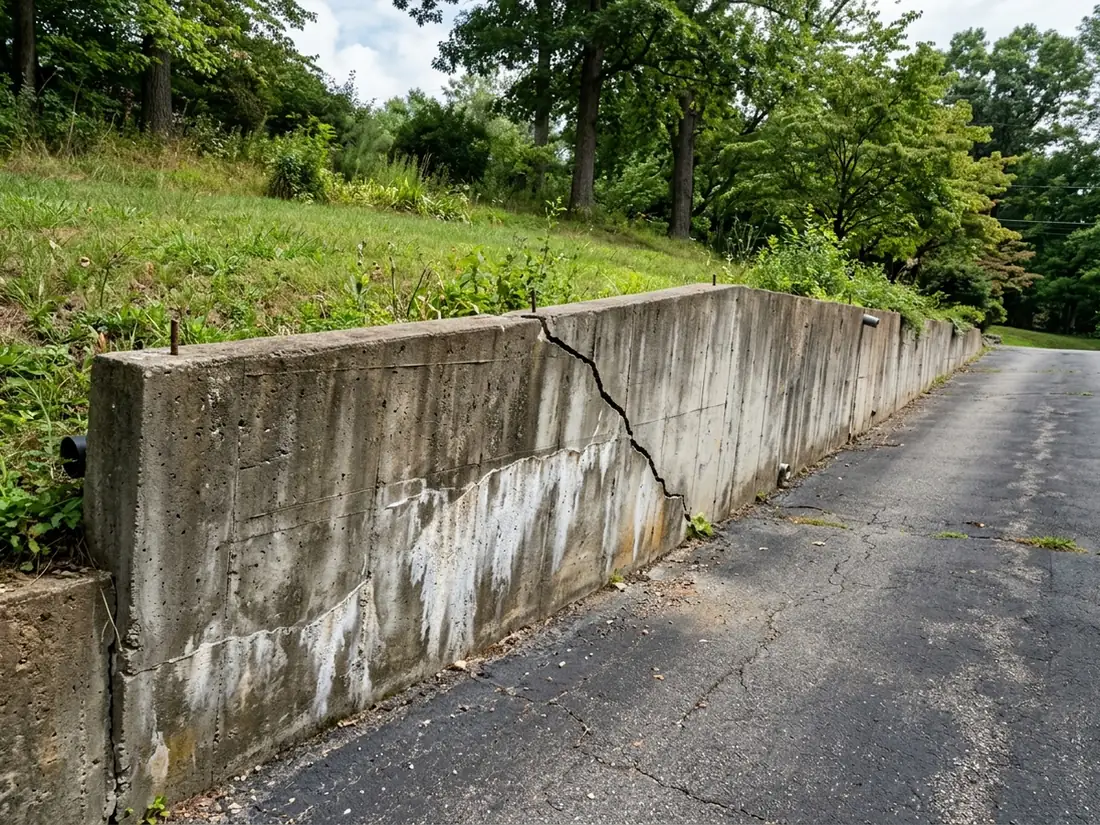
Poured Concrete Retaining Walls
Poured walls usually sit on a footing and stand as one piece, so they crack and tilt rather than bulge. A wall with no weep holes or drain often shows a white crust of efflorescence on its face where water has been pushing through.
The repairs:
- Tieback anchors run through the wall into the soil behind it and hold the top from tipping further. HomeGuide puts anchors at $60 to $80 per square foot.
- New drainage, cored weep holes or a drain dug in behind the wall.
- Crack repair where the wall is stable and only the crack needs sealing.
- Replacement when the wall has tipped too far or its footing has failed.
A poured wall that holds up a driveway or a slope with a house above it is the type most likely to need an engineer (see the code thresholds below).
Drainage Behind the Wall
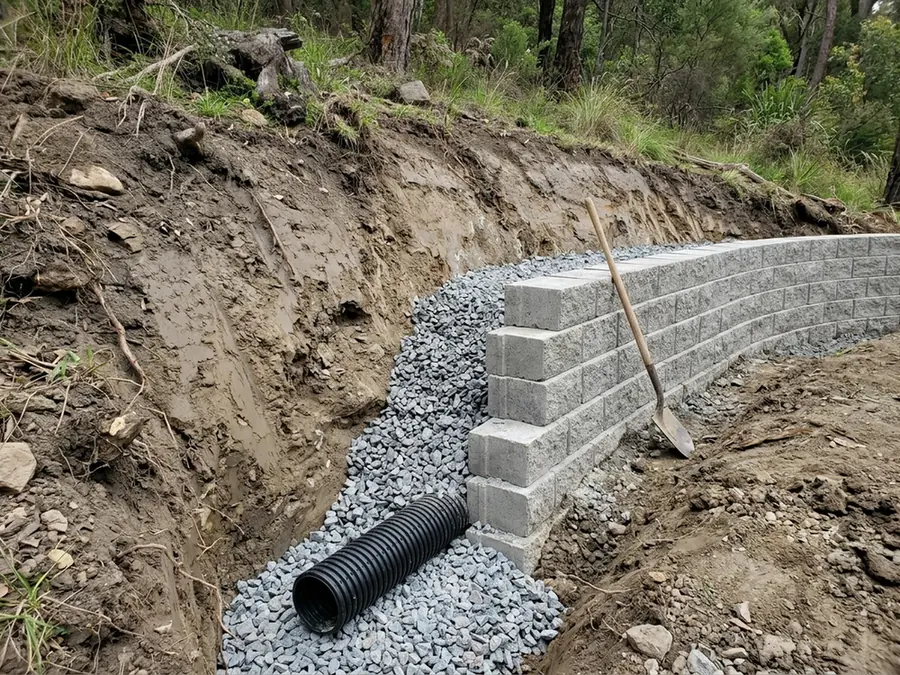
Whatever the wall is made of, the material behind it decides how long it lasts. The concrete masonry industry's design guide for segmental walls calls for at least 12 inches of free-draining aggregate behind the units, a drain pipe at least 3 inches in diameter, and outlets no more than 50 feet apart. It also says that gravel is only for incidental water. Surface water should be steered away from the wall in the first place, by grading, swales and downspout extensions. The same idea protects the house: Michigan's grading rule at the foundation is on basement leak repair.
HomeGuide's figure for adding drainage to an existing wall is $50 to $80 per square foot.
Why Ann Arbor homeowners call Ann Arbor Foundation Pros
- The estimate is free, and you can ask for it in writing
- Your request goes to one foundation contractor, not five
- Method, pier or brace count and price on paper before work starts
- The referral costs homeowners nothing
Does a Retaining Wall Repair Need a Permit or an Engineer?
Under Michigan's residential code, a retaining wall up to 4 feet tall, measured from the bottom of its footing to the top, needs no building permit unless it carries a surcharge such as a driveway, a slope or a structure above it. A wall that isn't braced at the top and holds back more than 48 inches of soil, or one over 24 inches that also carries other loads, has to be engineered.
That engineering rule asks for a safety factor of 1.5 against sliding and overturning. In practice it means a wall along a driveway, or one stepping a steep yard, often needs sealed drawings even when it isn't very tall. Check with the City of Ann Arbor's building department before the work starts; the contractor should know which side of the line your wall falls on.
Repair or Rebuild: What Does Retaining Wall Repair Cost?
HomeGuide's national range for repairing a retaining wall is $100 to $1,500, and $6,000 to $14,000 to remove and rebuild one. No source we found publishes Ann Arbor figures. Small fixes, like resetting a few blocks or coring weep holes, sit at the bottom of that range. In our view, a wall that is leaning along most of its length, has rotted anchors, or never had drainage behind it is headed for a rebuild.
Ask the estimate to state the wall's height from the footing, the drainage being added, the gravel depth behind it, and whether an engineer's drawing is included. If the wall stands against the house itself, it's a foundation wall, not a retaining wall, and bowing basement wall repair is the place to start.